

Heltec
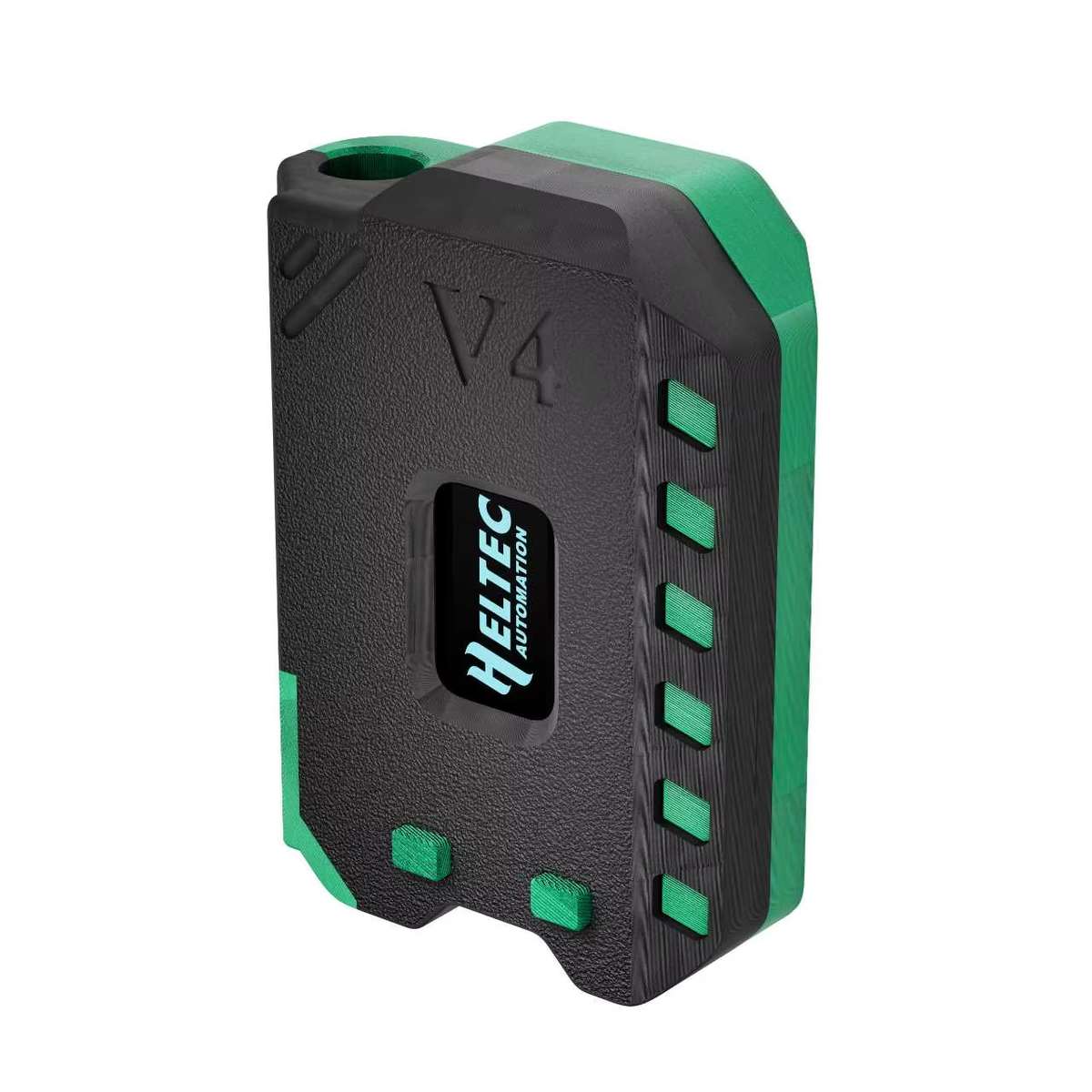
WiFi LoRa 32 v4 902-928 MHz Band with case - Meshtastic Compatible
WiFi LoRa 32 v4 902-928 MHz Band with case - Meshtastic Compatible
Couldn't load pickup availability
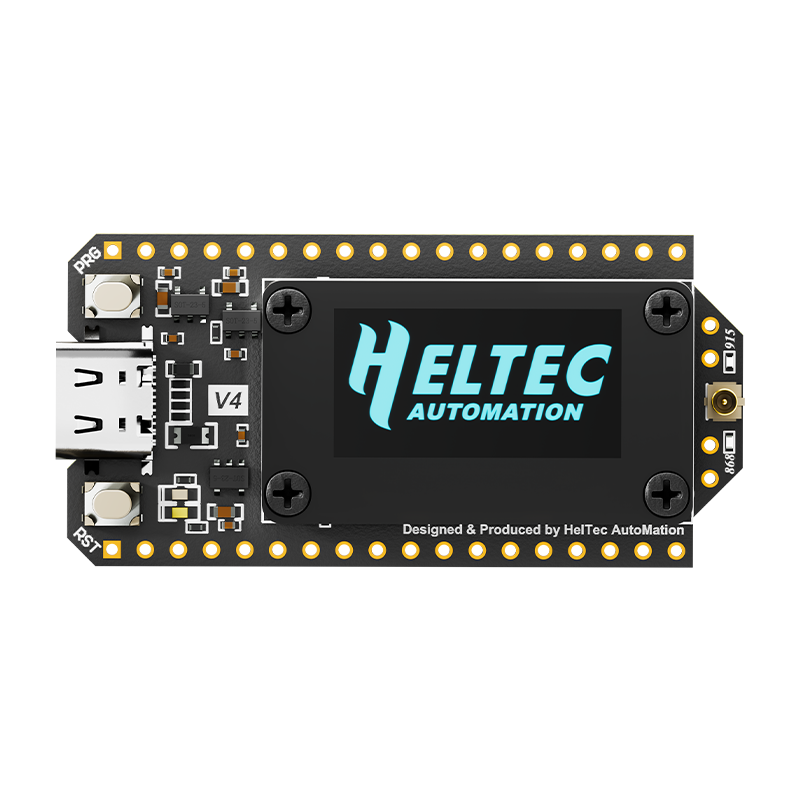
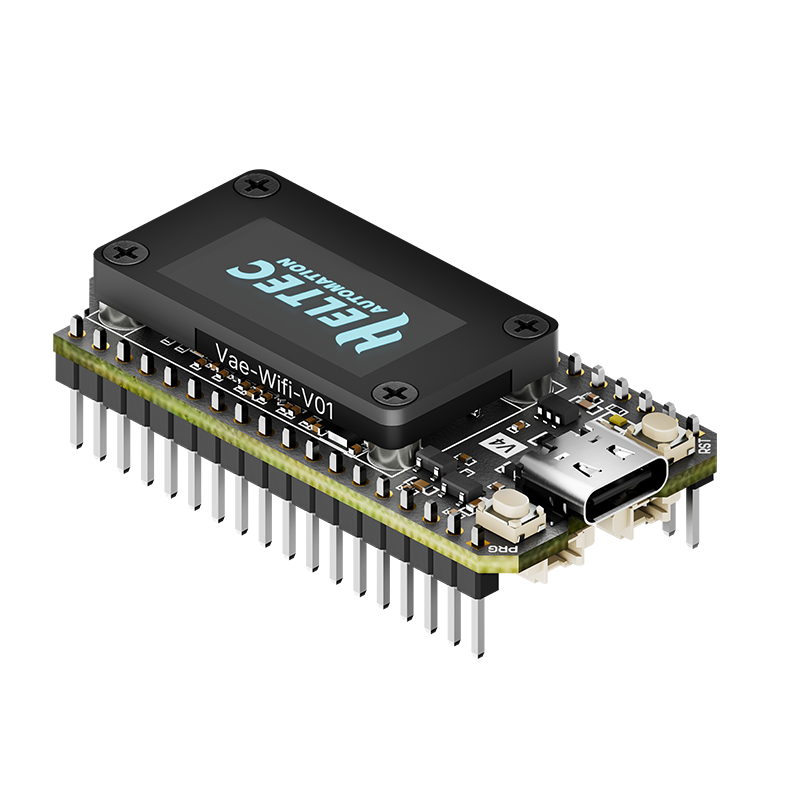
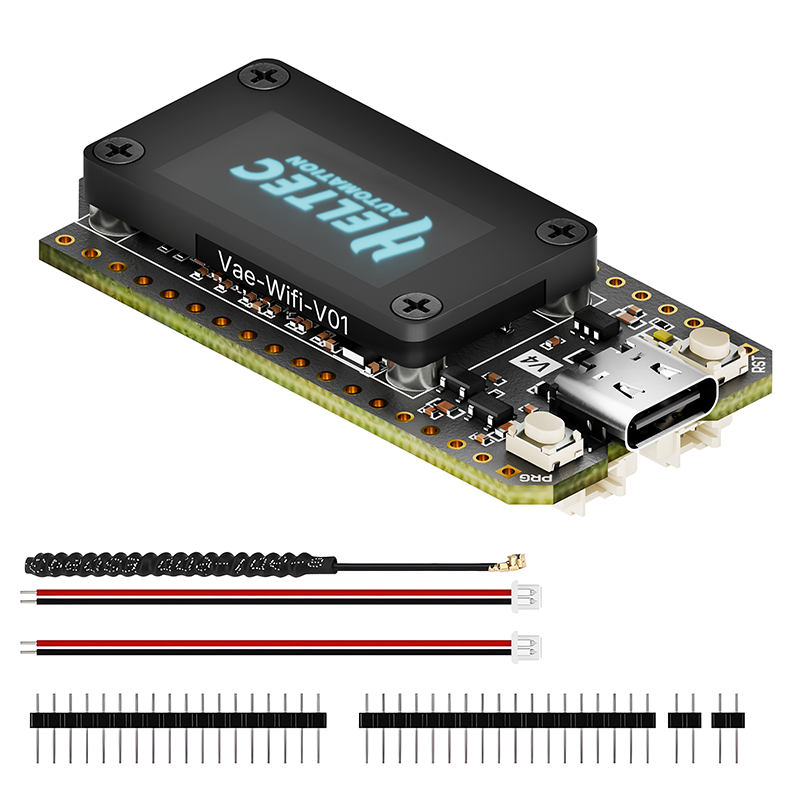
WiFi LoRa 32(V4), ESP32S3 + SX1262 LoRa Node, Meshtastic and LoRaWAN Compatible
WiFi LoRa 32 is a classic IoT development board widely used in many open-source projects and IoT products.
Summary
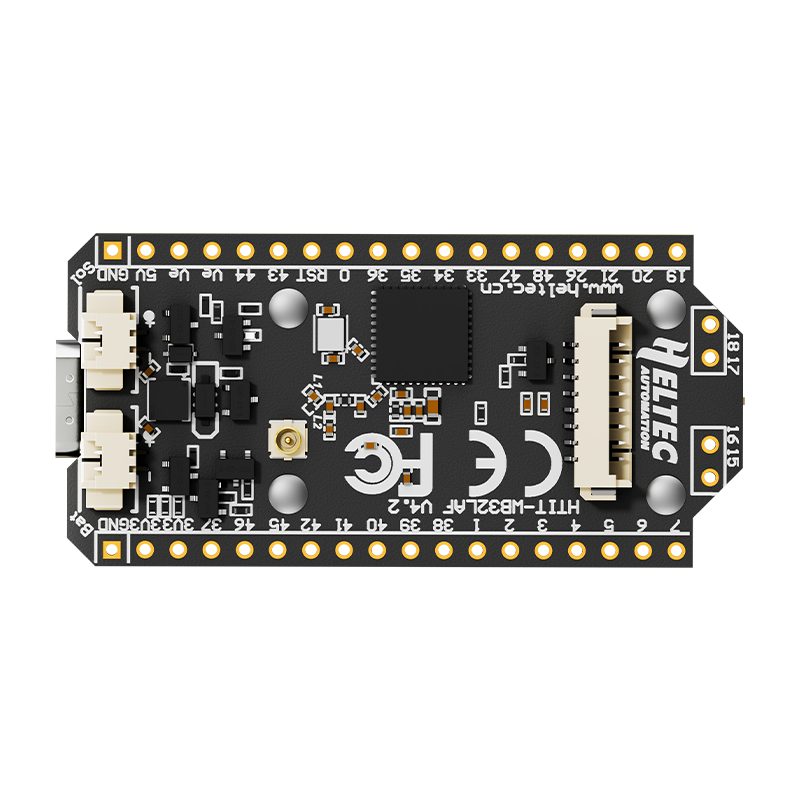
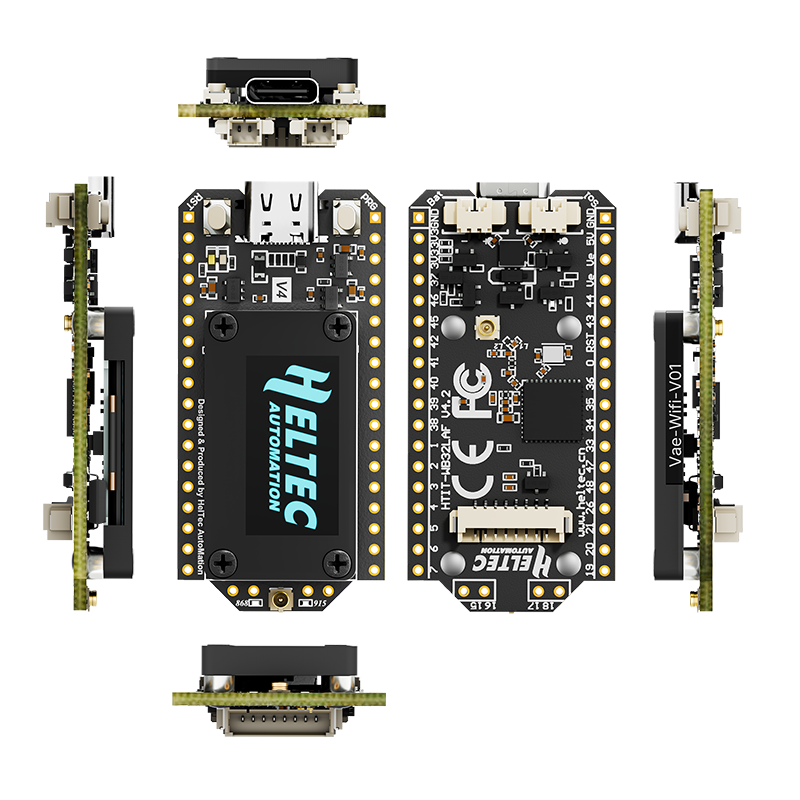
The WiFi LoRa 32 V4, the next gen to the Heltec V3, is a powerful, high-efficiency IoT maker board featuring an ESP32S3 MCU and SX1262 LoRa Node chip; retaining the V3’s size and identical pinout, it integrates performance upgrades including a built-in Wi-Fi/Bluetooth antenna, 28±1dBm LoRa output power, and a protected OLED display; its superior RF and stable system design ensure it’s ready-to-use and highly beginner-friendly, supporting development via Arduino, PlatformIO, ESP-IDF, and MicroPython; making it ideal for long-range wireless open-source projects like Meshtastic, LoRaWAN, and Meshcore in applications such as smart cities and industrial control, with custom hardware available on the Heltec MQB platform.
Main Features
Hardware Version Comparison
| Parameters | v3 | v4 |
| MCU | ESP32-S3FN8 | ESP32-S3R2 |
| Flash | 8MB (integrated) | 16MB (external) |
| USB to Serial Chip | CP2102 | Removed CP2102 |
| Power Management | Standard Li-ion management IC | Upgraded IC supporting solar input |
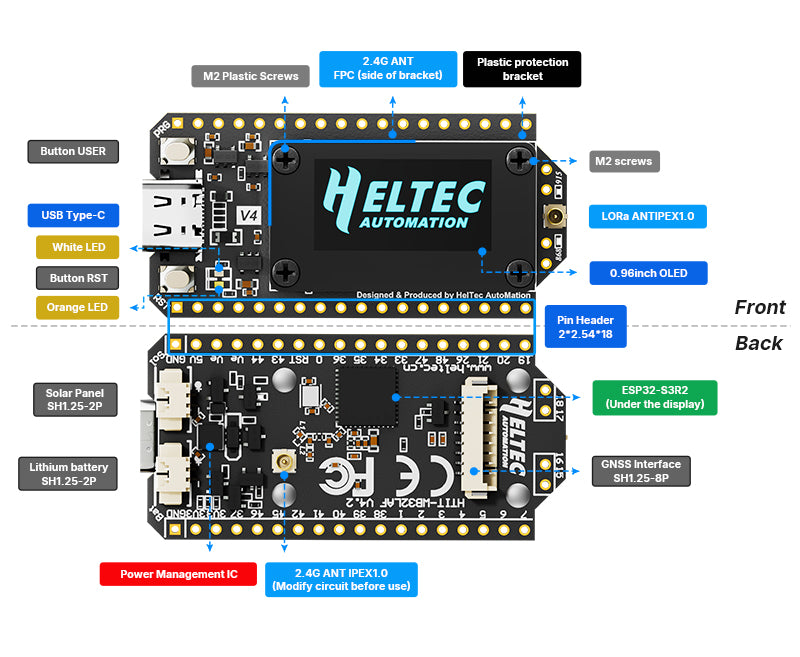
| Solar Input | Not available | Added 1.25-2P interface |
| LoRa TX Power | 21±1dBm | 28±1dBm |
| 2.4G Antenna | Metal spring antenna | FPC antenna + IPEX connector |
| GPS Interface | Not available | Added 1.25-8Pin interface |
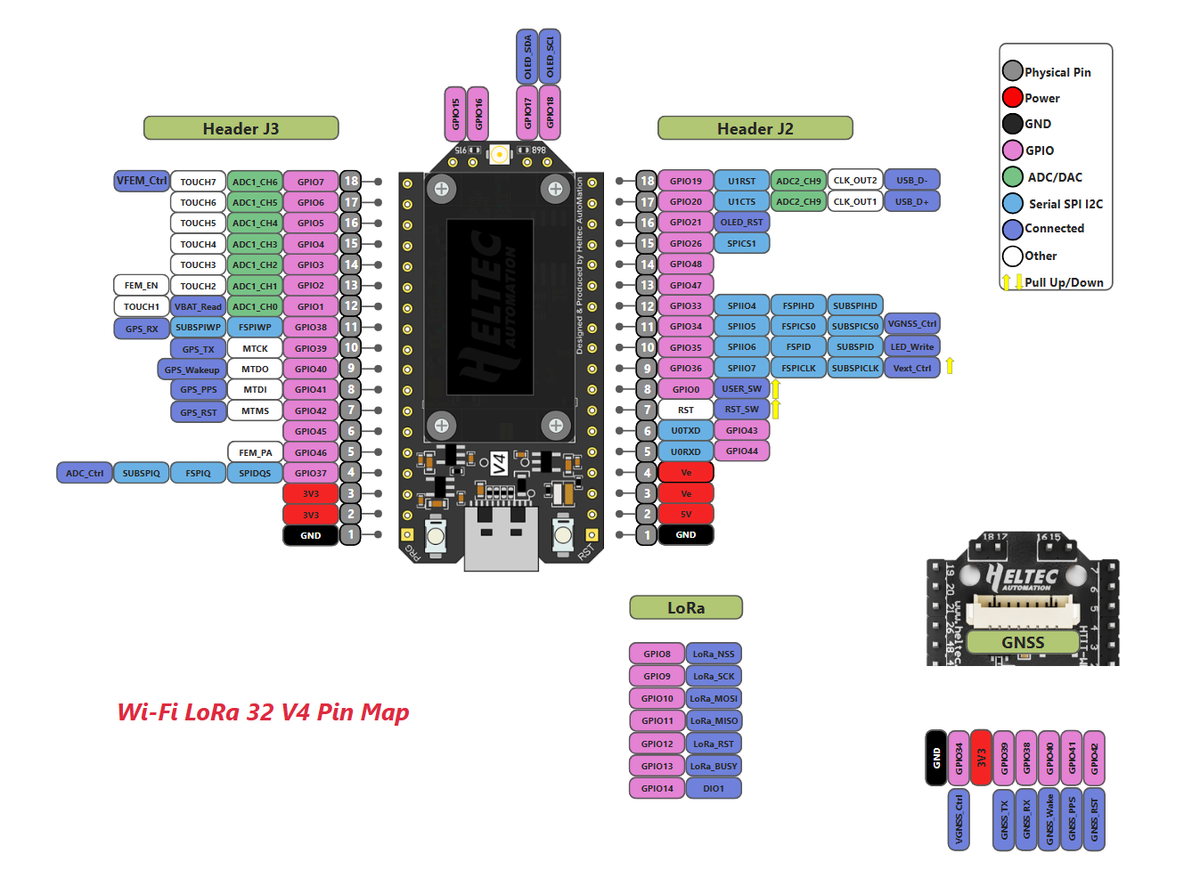
| Peripheral I/F | 36-pin | 40-pin |
| Screen Connection | Soldered | Soldered + B2B connector |
| Pin Craft | Silver-plated | Gold-plated |
| Screen Bracket | Partial protection | Full protection |
Highlight
More Powerful MCU - The ESP32-S3R2 offers 2MB of PSRAM and is equipped with an external 16MB Flash, making the upgraded memory configuration more suitable for Ul and complex system design.
Higher Transmission Power - The device is available in high-power and low-power versions. The high-power version offers a transmit power of up to 27±1dBm, enabling longer communication distances and adaptability to a wider range of application scenarios.
More Peripheral Interfaces
- Added 1.25*2P solar panel interface, supports 4.7~6V solar input
- Added 1.25°8P GNSS interface, GNSS power can be individual controlled.
- 1.25*2P lithium battery interface
Compatible with V3 Pinout
Almost entirely retains the form factor and pin layout of V3, while adding additional pins. The pin plating process has been upgraded from silver plating to gold plating.
Specfications
| Parameters | Description |
| MCU | ESP32-S3R2 (Xtensa®32-bit lx7 dual core processor) |
| LoRa Chip | SX1262 |
| Frequency |
High-power version: 863-928MHz Low-power version: 433, 470-510, 863-928MHz |
| Max. TX Power |
High-power version: 28 ±1 dBm Low-power version: 21 ±1 dBm |
| Max. Receiving sensitivity | -137dBm@SF12 BW=125KHz |
| Wi-Fi | 802.11 b/g/n, up to 150Mbps |
| Bluetooth | Bluetooth (LE), Bluetooth 5, Bluetooth Mesh |
| Hardware Resource |
7*ADC1 + 2*ADC2; 7*Touch; 3*UART; 2*I2C; 2*SPI; etc. |
| Memory | 384KB ROM; 512KB SRAM; 16KB RTC SRAM; 2MB PSRAM; 16MB Flash |
| Interface |
Type-C USB; 1.25*2 Pin lithium battery interface; 1.25*2 Pin Solar interface; 1.25*8 Pin interface; LoRa ANT(IPEX1.0); 2.4G ANT(IPEX1.0) |
| Battery applicable | 3.3-4.4V lithium battery |
| Operating Temperature | -20 ~ 70 ℃ |
| Dimensions | 51.7 * 25.4* 10.7mm |
FAQ
2.4GHz Antenna
The default 2.4G FPC antenna is located on the side of the plastic screen bracket.
Hardware 4.2
If you wish to use an IPEX-connected 2.4G antenna, you need to remove the inductor marked as ① in the diagram below, and add a 0-ohm resistor (or other conductive metal or cable) at the position marked ② to connect to the IPEX interface.

My screws look a bit odd?

This area is attached with a 2.4G FPC antenna, and to avoid affecting its performance, customised plastic screws are used here.
That’s why they look different from ordinary screws.
When you need to remove it, gently press and turn with a screwdriver.
- Arduino
- Micro Python
- Platform.io
- Espressif IDE
We strongly recommend using Arduino. Heltec have complete technical support and provide complete LoRaWAN code for ESP32 Arduino framework.
You can find this type of socket by search “SH1.25 x 2”.
They are compatible in most scenarios.
Since V4 uses the same series of chips as V3, features the same OLED, and has an almost identical pin layout, V3 and V4 can be used interchangeably in the majority of cases.
However, due to the increased transmit power, the transmit power settings in some code may no longer correspond directly to the actual output.
Please try the following steps:
-
Try using a different USB cable.
-
Enter BootLoader mode. There are two methods to enter this mode:
-
Hold down the PRG button, connect the USB-C cable, then release the PRG button.
-
Connect the USB-C cable, hold down the PRG button, press the RST button once, then release the PRG button.

It indicates simultaneous support for both 868 MHz and 915 MHz frequency bands.
In the initial design, we developed two separate hardware versions to achieve optimal RF performance. However, through subsequent debugging, we have successfully unified the hardware for both 868 MHz and 915 MHz while maintaining excellent RF characteristics.
It does not indicate device damage. Please disregard this phenomenon. The LORA ERROR occurs because it is running the factory default LORA testing program and cannot find another device running the same program.
Links
- Docs: https://wiki.heltec.org/docs/devices/open-source-hardware/esp32-series/lora-32/wifi-lora-32-v4/
- Schematic Diagram: https://resource.heltec.cn/download/WiFi_LoRa_32_V4/Schematic
- Datasheet: https://resource.heltec.cn/download/WiFi_LoRa_32_V4/datasheet/WiFi_LoRa_32_V4.2.0.pdf
- 3D Model Diagram: https://resource.heltec.cn/download/WiFi_LoRa_32_V4/3D
- Downloadable Resources: https://resource.heltec.cn/download/WiFi_LoRa_32_V4/
- Heltec ESP32 Development Framework (Board Manager, Basic Examples): https://github.com/Heltec-Aaron-Lee/WiFi_Kit_series
- Heltec ESP32 Extension Libraries (LoRa/LoRaWAN, Sensors, etc.): https://github.com/HelTecAutomation/Heltec_ESP32